2026-11-05
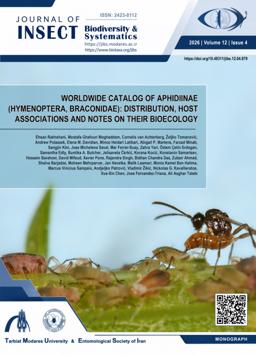
Worldwide catalog of Aphidiinae (Hymenoptera, Braconidae): distribution, host associations and notes on their bioecology
Publication
Publication
Journal of Insect Biodiversity and Systematics , Volume 12 - Issue 4 p. 879- 1477
In this Monograph, the Aphidiinae of the world are cataloged. A total of 733 valid species in 67 genera are recorded, comprising 704 extant species in 54 genera and 29 fossil species assigned to 15 genera. The Palaearctic region contains the largest documented aphidiine fauna. Generic diversity is strongly skewed, with 34 genera represented by a single species and a few species-rich genera accounting for a disproportionate share of the known fauna. Distributions are given according to a scheme of biogeographical divisions developed for this catalog and are most finely divided for the Afrotropical, Australasian, Holarctic (Palaearctic + Nearctic), Neotropical, Oceanic, and Oriental regions. The catalog is based on examination of the primary literature comprising more than 3,370 references from 1818–2026. Nomenclatural details are provided for nominal genera and species, including synonyms at both levels for taxa described or recorded worldwide. For valid species, distributions are provided along with complete name-bearing type data for associated names. Host aphids belong to 1,070 species within 215 genera. A replacement name, Pauesia shii Ghafouri Moghaddam, nom. nov., is proposed for Pauesia rugosa Shi, 2001, a junior primary homonym of Pauesia rugosa Starý & Remaudière, 1982. Herein, we present 146 new country records involving genera and species from 48 countries. Notably, this study provides the first confirmed records of the subfamily Aphidiinae from four countries: Jamaica, Papua New Guinea, São Tomé and Príncipe, and Suriname. Country-level faunal analyses across 142 countries and territories revealed a strongly uneven distribution of documented richness: Russia, the USA, France, India, and China were among the faunistically richest countries. Species richness was strongly associated with generic richness but only weakly related to country area. Europe had the highest median country-level richness, followed by Asia. The long-tailed richness profile showed that a small number of countries contribute a disproportionate share of the documented fauna, whereas several countries still lack published distributional records. These patterns reveal both genuine biogeographical structure and major geographical biases in sampling and taxonomic coverage, providing a baseline for future inventory, taxonomic revision, and research related to biological control. In addition, photographs for more than half of the species, alongside an updated compilation of their biological data, with particular emphasis on their use in biological control are presented.
| Additional Metadata | |
|---|---|
| , , , , , , , , , , , | |
| Journal of Insect Biodiversity and Systematics | |
| Released under the CC-BY NC 4.0 (“Attribution-NonCommercial 4.0 International”) License | |
| Organisation | Staff publications |
|
Ehsan Rakhshani, Mostafa Ghafouri-Moghaddam, van Achterberg, C.& others, . (2026). Worldwide catalog of Aphidiinae (Hymenoptera, Braconidae): distribution, host associations and notes on their bioecology. In Journal of Insect Biodiversity and Systematics (Vol. 12, Number 4, pp. 879–1477). |
|