2026-10-01
Placing very long branch taxa in the plant tree of life: A case study with Dioscoreales mycoheterotrophs
Publication
Publication
American Journal of Botany , Volume 2026 - Issue e70267
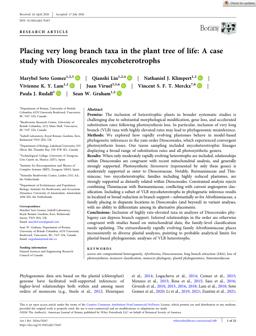
PREMISE: The inclusion of heterotrophic plants in broader systematic studies is challenging due to substantial morphological modification, gene loss, and accelerated substitution rates following photosynthesis loss. In particular, inclusion of very long branch (VLB) taxa with highly elevated rates may lead to phylogenomic misinference. METHODS: We explored how rapidly evolving plastomes behave in model-based phylogenetic inferences in the yam order Dioscoreales, which experienced convergent photosynthesis losses. Our taxon sampling included mycoheterotrophic lineages displaying a broad range of substitution rates and all photosynthetic genera. RESULTS: When only moderately rapidly evolving heterotrophs are included, relationships within Dioscoreales are congruent with recent mitochondrial analysis, and generally strongly supported. Photosynthetic Stenomeris (represented by only three genes) is moderately supported as sister to Dioscoreaceae. Notably, Burmanniaceae and Thismiaceae, two mycoheterotrophic families including highly reduced plastomes, are strongly supported as distantly related within Dioscoreales. Constrained analysis rejects combining Thismiaceae with Burmanniaceae, conflicting with current angiosperm classification. Including a subset of VLB mycoheterotrophs in phylogenetic inference results in localized or broad reduction in branch support-substantially so for Afrothismiaceae, a family placing in disparate locations in Dioscoreales (and beyond) in variant analyses, with no ability to differentiate among its alternative placements. CONCLUSIONS: Inclusion of highly rate-elevated taxa in analyses of Dioscoreales phylogeny can depress branch support. Inferred relationships in the order are otherwise congruent with studies based on mitochondrial data; the family-level classification needs updating. The extraordinarily rapidly evolving family Afrothismiaceae places inconsistently in diverse plastid analyses, pointing to probable analytical limits for plastid-based phylogenomic analyses of VLB heterotrophs.
| Additional Metadata | |
|---|---|
| , , , , , , , , , | |
| James Hutton Institute, Compute Canada, Western Canada Research Grid, Korea University, Natural Sciences and Engineering Research Council of Canada, Biotechnology and Biological Sciences Research Council, Biotechnology and Biological Sciences Research Council, Agencia Estatal de Investigación | |
| doi.org/10.1002/ajb2.70267 | |
| American Journal of Botany | |
| Released under the CC BY-NC-ND 4.0 (“Attribution-NonCommercial-NoDerivs 4.0 International”) Licence | |
| Organisation | Staff publications |
|
Marybel Soto Gomez, Qianshi Lin, Nathaniel J. Klimpert, Vivienne K. Y. Lam, Juan Viruel, Merckx, V., Paula J. Rudall& Sean W. Graham. (2026). Placing very long branch taxa in the plant tree of life: A case study with Dioscoreales mycoheterotrophs. American Journal of Botany, 2026(e70267).https://doi.org/10.1002/ajb2.70267 |
|