2026-06-16
Clogmia albipunctata larvae influence the odour dynamics of rotting organic matter
Publication
Publication
Entomologia Experimentalis et Applicata , Volume 2026
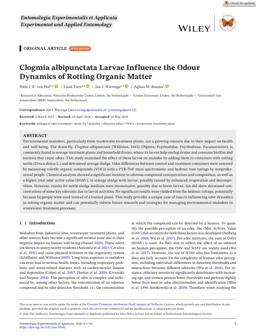
Environmental malodors, particularly from wastewater treatment plants, are a growing concern due to their impact on health and well-being. The drain fly, Clogmia albipunctata (Williston, 1893) (Diptera: Psychodidae, Psychodinae, Paramormiini), is commonly found in sewage treatment plants and household drains, where its larvae help unclog drains and consume biofilm and bacteria that cause odors. This study examined the effect of these larvae on malodor by adding them to containers with rotting nettle (Urtica dioica L.) and dewatered sewage sludge. Odor differences between control and treatment containers were assessed by measuring volatile organic compounds (VOCs) with a PTR–ToF mass spectrometer and hedonic tone ratings by nonprofessional people. Chemical analysis showed a significant increase in odorous compound concentrations and composition, as well as a higher total odor active value (SOAV), in sewage sludge with larvae, possibly caused by enhanced evaporation and decomposition. However, results for nettle sludge medium were inconclusive, possibly due to fewer larvae, but did show decreased concentrations of some key odorants due to larval activities. No significant results were yielded from the hedonic ratings, potentially because laypeople were used instead of a trained panel. This study provides a unique case of insects influencing odor dynamics in rotting organic matter and can potentially inform future research and strategies for managing environmental malodors in wastewater treatment processes.
| Additional Metadata | |
|---|---|
| , , , , , | |
| doi.org/10.1111/eea.70142 | |
| Entomologia Experimentalis et Applicata | |
| Released under the CC BY-NC-ND 4.0 (“Attribution-NonCommercial-NoDerivs 4.0 International”) Licence | |
| Organisation | Staff publications |
|
van Hof, N., Torn, L., Wieringa, J.& Bouma, A. (2026). Clogmia albipunctata larvae influence the odour dynamics of rotting organic matter. Entomologia Experimentalis Et Applicata, 2026.https://doi.org/10.1111/eea.70142 |
|