2026-01-10
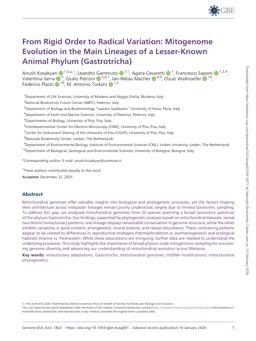
From rigid order to radical variation: mitogenome evolution in the main lineages of a lesser-known animal phylum (Gastrotricha)
Publication
Publication
Genome Biology and Evolution , Volume 18 - Issue 2
Mitochondrial genomes offer valuable insights into biological and phylogenetic processes, yet the factors shaping their architecture across metazoan lineages remain poorly understood, largely due to limited taxonomic sampling. To address this gap, we analyzed mitochondrial genomes from 20 species spanning a broad taxonomic spectrum of the phylum Gastrotricha. Our findings, supported by phylogenetic analyses based on mitochondrial datasets, reveal two distinct evolutionary patterns: one lineage displays remarkable conservation in genome structure, while the other exhibits variability in gene content, arrangement, strand polarity, and repeat abundance. These contrasting patterns appear to be related to differences in reproductive strategies (hermaphroditism vs. parthenogenesis) and ecological habitats (marine vs. freshwater). While these associations are intriguing, further data are needed to understand the underlying processes. This study highlights the importance of broad phylum-scale mitogenomic sampling for uncovering genomic diversity and advancing our understanding of mitochondrial evolution across Metazoa.
| Additional Metadata | |
|---|---|
| , , , , , | |
| doi.org/10.1093/gbe/evag001 | |
| Genome Biology and Evolution | |
| Released under the CC-BY 4.0 (“Attribution 4.0 International”) License | |
| Organisation | Staff publications |
|
Kosakyan, Anush, Gammuto, Leandro, Cesaretti, Agata, Saponi, Francesco, Serra, Valentina, Petroni, Giulio, … Todaro, M Antonio. (2026). From rigid order to radical variation: mitogenome evolution in the main lineages of a lesser-known animal phylum (Gastrotricha). Genome Biology and Evolution, 18(2). doi:10.1093/gbe/evag001 |
|