2025-04-01
Cultivation of anammox bacteria from a tropical lake in Indonesia using a novel filter bioreactor to enhance nitrogen removal efficiency
Publication
Publication
Water Science & Technology , Volume 91 - Issue 7 p. 811- 826
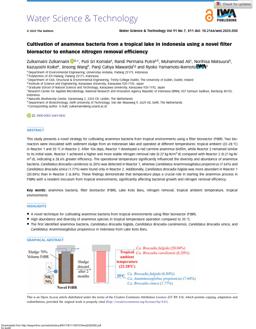
This study presents a novel strategy for cultivating anammox bacteria from tropical environments using a filter bioreactor (FtBR). Two bioreactors were inoculated with sediment sludge from an Indonesian lake and operated at different temperatures: tropical ambient (22–28 °C) in Reactor 1 and 35 °C in Reactor 2. After 106 days, Reactor 1 developed a red carmine anammox biofilm, while Reactor 2 remained similar to its initial state. Reactor 1 achieved a higher and more stable nitrogen removal rate (0.27 kg-N/m3·d) compared with Reactor 2 (0.21 kg-N/m3·d), indicating a 28.6% greater efficiency. The operational temperature significantly influenced the diversity and abundance of anammox bacteria. Candidatus Brocadia caroliensis (6.20%) was detected in Reactor 1, whereas Candidatus Anammoxoglobus propionicus (7.64%) and Candidatus Brocadia sinica (1.77%) were found only in Reactor 2. Additionally, Candidatus Brocadia fulgida was more abundant in Reactor 1 (20.04%) than in Reactor 2 (6.84%). These findings demonstrate that temperature plays a crucial role in starting the anammox process in FtBRs with a resident inoculum from tropical environments, significantly affecting bacterial growth and nitrogen removal efficiency.
| Additional Metadata | |
|---|---|
| , , , , , , | |
| doi.org/10.2166/wst.2025.050 | |
| Water Science & Technology | |
| Released under the CC-BY 4.0 (“Attribution 4.0 International”) License | |
| Organisation | Staff publications |
|
Zulkarnaini, Zulkarnaini, Komala, Puti Sri, Putra, Randi Permana, Ali, Muhammad, Matsuura, Norihisa, Koike, Kazuyoshi, … Yamamoto-Ikemoto, Ryoko. (2025). Cultivation of anammox bacteria from a tropical lake in Indonesia using a novel filter bioreactor to enhance nitrogen removal efficiency. Water Science & Technology, 91(7), 811–826. doi:10.2166/wst.2025.050 |
|