2020
Wie het kleine niet eert ... De getijdeslak (Mercuria anatina) in Nederland
Publication
Publication
Nederlandse Archeologische Rapporten , Volume 70 p. 39- 47
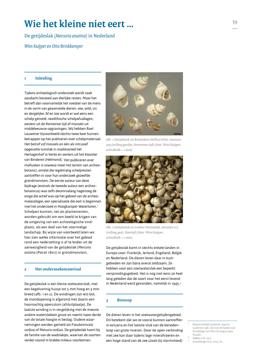
In this contribution to the liber amicorum for Roel Lauwerier, we present the occurrence of the mollusc Mercuria anatina (swollen spire snail) in the past and present. Its Dutch name getijdeslak (tidal snail) links to the natural distribution area of this species. Our snail is characteristic of freshwater tidal regions of rivers and geographically limited to France, Belgium, the Netherlands, England and Ireland. The archaeological and geological finds of Mercuria anatina reveal a considerably wider distribution in the past compared to the finds of living animals since 1945. The palaeo-geographic development of the Dutch coastline, with a gradual closure of the tidal inlets since Neolithic times and the reclamation of many areas for cultivation, explains the limited present distribu- tion. Reversely, the presence of Mercuria anatina in archaeological contexts may also provide additional information on the environment of a site at a certain period in the past, as is shown in the case of the Roman Period site Voorburg- Forum Hadriani, which is not clearly connected to a tidal inlet on the palaeo-geographic map of 100 AD. In Vlaardingen-Hoogstad, a drainage system of dams and culverts was dated in the Late Iron Age and the Roman Period. One of the culverts had a valve at the off-stream side, that only functions in a tidal environment. A large number of Mercuria anatina revealed that the environment was a freshwater tidal area here. It is therefore worthwhile to continue the study of molluscs from archaeological excavations.
| Additional Metadata | |
|---|---|
| Rijksdienst voor het Cultureel Erfgoed | |
| Nederlandse Archeologische Rapporten | |
| Organisation | Staff publications |
|
Kuijper, W.& O. Brinkkemper (Otto). (2020). Wie het kleine niet eert .. De getijdeslak (Mercuria anatina) in Nederland. Nederlandse Archeologische Rapporten, 70, 39–47. |
|