2025-12-10
Adhesive metagenomics: unlocking information on the assembly of historic herbaria
Publication
Publication
Botanical Journal of the Linnean Society , Volume 2025 - Issue boaf096
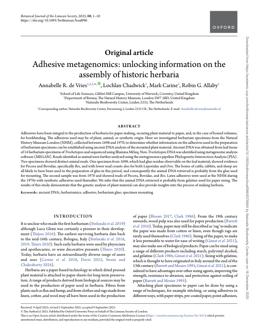
Adhesives have been integral to the production of herbaria for paper making, securing plant material to paper, and, in the case of bound volumes, for bookbinding. The adhesives used may be of plant, animal, or synthetic origin. Here we investigated herbarium specimens from the Natural History Museum London (NHM), collected between 1698 and 1970, to determine whether information on the adhesives used in the preparation of herbarium specimens can be established using ancient DNA analysis of the mounted plant material. Ancient DNA was obtained from leaf tissue of 14 herbarium specimens of Trochetiopsis and sequenced using Illumina MiSeq. Non-Trochetiopsis DNA was identified using metagenome analysis software (MEGAN). Reads identified as animal were further analysed using the metagenomics pipeline Phylogenetic Intersection Analysis (PIA). Two specimens showed distinct animal reads. One specimen from 1698, which had glue residue observable on the leaf material, showed evidence for Pecora and Bovidae, specifically Bos, and with lower read counts also for both Leporidae and Ovis. The bones of cattle, rabbits, and sheep are all likely to have been used in the preparation of glue in this period, and consequently the animal DNA retrieved is probably from the glue used for mounting. The second sample was from 1970 and showed reads of Pecora, Bovidae, and Bos. Latex adhesives were used at the NHM during the 1970s with synthetic adhesives used thereafter. We infer that the animal DNA retrieved is probably from gelatine used for paper sizing. The results of this study demonstrate that the genetic analysis of plant material can also provide insights into the process of making herbaria.
| Additional Metadata | |
|---|---|
| , , , , | |
| doi.org/10.1093/botlinnean/boaf096 | |
| Botanical Journal of the Linnean Society | |
| Released under the CC-BY 4.0 (“Attribution 4.0 International”) License | |
| Organisation | Staff publications |
|
de Vries, A., L. Chadwick, M. Carine& R.G. Allaby. (2025). Adhesive metagenomics: unlocking information on the assembly of historic herbaria. Botanical Journal of the Linnean Society, 2025(boaf096).https://doi.org/10.1093/botlinnean/boaf096 |
|