2025-11-11
Decoding the bare necessities of decapod crustacean nomenclature through the ages
Publication
Publication
PeerJ , Volume 13 - Issue e20337
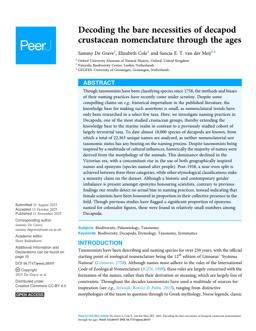
Though taxonomists have been classifying species since 1758, the methods and biases of their naming practices have recently come under scrutiny. Despite some compelling claims on e.g., historical imperialism in the published literature, the knowledge base for making such assertions is small, as nomenclatural trends have only been researched in a select few taxa. Here, we investigate naming practices in Decapoda, one of the most studied crustacean groups, thereby extending the knowledge base to the marine realm in contrast to a previously studied cohort of largely terrestrial taxa. To date almost 18,000 species of decapods are known, from which a total of 22,363 unique names are analysed, as neither nomenclatorial nor taxonomic status has any bearing on the naming process. Despite taxonomists being inspired by a multitude of cultural influences, historically the majority of names were derived from the morphology of the animals. This dominance declined in the Victorian era, with a concomitant rise in the use of both geographically inspired names and eponyms (species named after people). Post-1958, a near-even split is achieved between these three categories, while other etymological classifications stake a minority claim on the dataset. Although a historic and contemporary gender imbalance is present amongst eponyms honouring scientists, contrary to previous findings our results detect no actual bias in naming practices, instead indicating that female scientists have been honoured in proportion to their collective presence in the field. Though previous studies have flagged a significant proportion of eponyms named for colonialist figures, these were found in relatively small numbers among Decapoda.
| Additional Metadata | |
|---|---|
| , , , , | |
| doi.org/10.7717/peerj.20337 | |
| PeerJ | |
| Released under the CC-BY 4.0 (“Attribution 4.0 International”) License | |
| Organisation | Staff publications |
|
S. De Grave, E. Cole, & van der Meij, S. (2025). Decoding the bare necessities of decapod crustacean nomenclature through the ages. PeerJ, 13(e20337). doi:10.7717/peerj.20337 |
|