2025-10-30
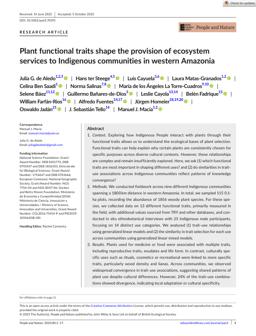
Plant functional traits shape the provision of ecosystem services to Indigenous communities in western Amazonia
Publication
Publication
People and Nature , Volume 2025
- Context.
Exploring how Indigenous People interact with plants through their functional traits allows us to understand the ecological bases of plant selection. Functional traits can help explain why certain plants are consistently chosen for specific purposes across diverse cultural contexts. However, these relationships are complex and remain insufficiently explored. Here, we ask (1) which functional traits are most important in shaping different uses? and (2) do similarities in trait–use associations across Indigenous communities reflect patterns of knowledgeconvergence? - Methods.
We conducted fieldwork across nine different Indigenous communities spanning a 1800 km distance in western Amazonia. In total, we sampled 115 0.1-ha plots, recording the abundance of 1856 woody plant species. For these species, we collected data on 13 different functional traits, primarily measured in the field, with additional values sourced from TRY and other databases, and conducted in situ ethnobotanical interviews with 25 Indigenous male participants, focusing on 14 distinct use categories. We analysed (1) trait–use relationships using generalized linear models and (2) the similarity in trait selection for each use across communities using generalized linear mixed models. - Results.
Plants used for medicine or food were associated with multiple traits, including reproductive traits, exudates and life form. In contrast, culturally specific uses such as rituals, cosmetics or recreational were linked to more specific traits, particularly wood density and lianas. Across communities, we observed widespread convergence in trait–use associations, suggesting shared patterns of plant use despite cultural differences. However, 24% of the trait–use combinations showed divergence, indicating local adaptation or cultural specificity. - Synthesis and applications.
Plant selection by Indigenous communities is not random; rather, it is guided by functional traits that consistently support human well-being. We named this pattern ‘functional selection convergence’, highlighting how ecological function and traditional knowledge interact across distinct cultural contexts. This convergence shows the importance of functional ecology explaining traditional plant selection. Our findings are a call for a trait-based ethnobotanical approach to document and better preserve the ecosystem services essential to Indigenous livelihoods. Nevertheless, we emphasize the need for future research to involve broader and more diverse ethnobotanical participation.
| Additional Metadata | |
|---|---|
| , , , , , , , | |
| doi.org/10.1002/pan3.70191 | |
| People and Nature | |
| Released under the CC-BY 4.0 (“Attribution 4.0 International”) License | |
| Organisation | Staff publications |
|
de Aledo, Julia G., ter Steege, H., Cayuela, Luis, Matas‐Granados, Laura, Ben Saadi, Celina, Salinas, Norma, … Macía, Manuel J. (2025). Plant functional traits shape the provision of ecosystem services to Indigenous communities in western Amazonia. People and Nature, 2025. doi:10.1002/pan3.70191 |
|