2025-10-31
MtDNA barcoding illuminates native diversity and introduction pathways of slow worms in The Netherlands
Publication
Publication
Amphibia-Reptilia , Volume 2025 p. 1- 7
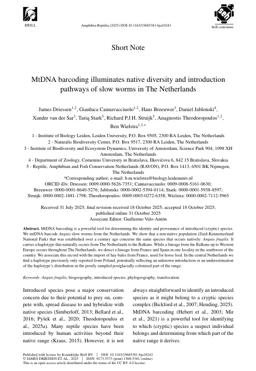
MtDNA barcoding is a powerful tool for determining the identity and provenance of introduced (cryptic) species. We mtDNA barcode Anguis slow worms from the Netherlands. We show that a non-native population (Zuid-Kennemerland National Park) that was established over a century ago concerns the same species that occurs natively: Anguis fragilis. It carries a haplotype that naturally occurs from The Netherlands to the Balkans. While a lineage from the Balkans up to Western Europe occurs throughout The Netherlands, we detect a lineage from France and Spain in one locality in the southwest of the country. We associate this record with the import of hay bales from France, used for horse feed. In the central Netherlands we find a haplotype previously only reported from Poland, potentially reflecting an unknown introduction or an underestimation of the haplotype’s distribution in the poorly sampled postglacially colonized part of the range.
| Additional Metadata | |
|---|---|
| , , , , | |
| doi.org/10.1163/15685381-bja10243 | |
| Amphibia-Reptilia | |
| Released under the CC-BY 4.0 (“Attribution 4.0 International”) License | |
| Organisation | Staff publications |
|
Driessen, J., Cannavacciuolo, G., Breeuwer, Hans, Jablonski, Daniel, van der Sar, Xander, Stark, Tariq, … Wielstra, B. (2025). MtDNA barcoding illuminates native diversity and introduction pathways of slow worms in The Netherlands. Amphibia-Reptilia (Vol. 2025, pp. 1–7). doi:10.1163/15685381-bja10243 |
|