2009-03-19
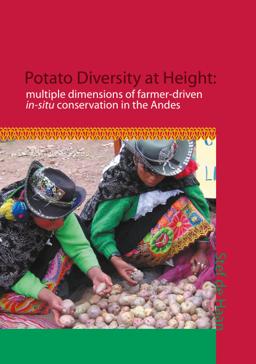
Potato diversity at height: multiple dimensions of farmer-driven in-situ conservation in the Andes
Publication
Publication
Justification:
On-farm or in-situ conservation has become a well established and recognized approach for
crop genetic resource conservation. A few decades ago, at the start of the green revolution, it
was considered inevitable that modern cultivars from breeding programs would almost
completely replace native cultivars maintained by farmers in centers of crop origin. However, the “wipe out” doom scenario did not fully fulfill itself and millions of farmers around the world still actively grow and maintain ancestral cultivars of diverse crop species.
Nowadays in-situ conservation is valued as complementary to global ex-situ conservation. It
supports ongoing crop evolution while maintaining dynamic indigenous knowledge systems
that surround crop genetic resources. The theoretical, conceptual and developmental framework of in-situ conservation is
still evolving but has advanced considerably during the last decade.
Brush (2000) distinguishes between two types of in-situ conservation. First, the persistence
of crop genetic resources in areas where everyday practices of farmers maintain diversity on
their farms. This type of in-situ conservation is “farmer-driven” and both a historical and ongoing
phenomenon (Brush, 2000; Zimmerer, 1993). The second type concerns Research &
Development (R&D) strategies designed to foment in-situ conservation by farmers. This type
of in-situ conservation is “externally driven” and implemented by special projects, NGO’s and
governmental agencies, among others. The two types of in-situ conservation are connected
in the sense that the success of externally driven strategies arguably depends on a good
understanding of farmer-driven in-situ conservation. The other way around, the impact of
externally driven strategies on farmer-driven in-situ conservation should preferably be well
understood so that R&D interventions can become increasingly intelligent and targeted.
| Additional Metadata | |
|---|---|
| doi.org/10.18174/2715 | |
| Organisation | Staff publications |
|
Haan, S. (2009). Potato diversity at height: multiple dimensions of farmer-driven in-situ conservation in the Andes.https://doi.org/10.18174/2715 |
|