2025-08-27
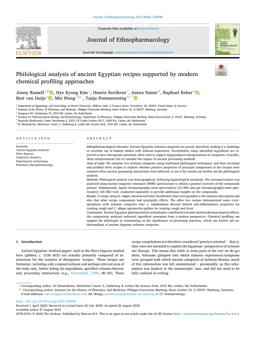
Philological analysis of ancient Egyptian recipes supported by modern chemical profiling approaches
Publication
Publication
Journal of Ethnopharmacology , Volume 354 - Issue 120498
Ethnopharmacological relevance
Ancient Egyptian sickness categories are poorly described, making it a challenge to correlate use of materia medica with sickness experience. Nevertheless, many identified ingredients are reported to have therapeutic potential, often used to support Egyptological interpretations of categories. Crucially, these interpretations fail to consider the impact of ancient processing methods.
Aims of study
We examine two sickness categories using traditional philological techniques, and then recreated and profiled three recipes to explore whether putative properties of principal components of the recipes were retained when ancient processing instructions were followed, to see if the results can further aid the philological analysis.
Methods
Philological analysis was lexicographical, following Egyptological standards. The recreated matter was analysed using nuclear magnetic resonance (NMR) spectroscopy to obtain a general overview of the compounds present. Subsequently, liquid chromatography-mass spectrometry (LC-MS) and gas chromatography-mass spectrometry (GC-MS) were conducted separately to provide additional insights on the compounds.
Results
A recipe using H. vulgare showed activities (hordenine) that corresponded to the sickness description and also that other recipe components had synergistic effects. The other two recipes demonstrated some correspondence with sickness categories also: L. usitatissimum showed limited anti-inflammatory properties for treating cough and C. siliqua epicatechin/gallate for treating cough and fever.
Conclusions
Ancient Egyptian pharmaceutical technologies contributed towards desired pharmacological effects, the compositum analysed indicated ingredient synergism from a modern perspective. Chemical profiling can support the philologist in commenting on the significance of processing practices, which can further aid understandings of ancient Egyptian sickness categories.
| Additional Metadata | |
|---|---|
| doi.org/10.1016/j.jep.2025.120498 | |
| Journal of Ethnopharmacology | |
| Released under the CC-BY 4.0 (“Attribution 4.0 International”) License | |
| Organisation | Staff publications |
|
Russell, Jonny, Kim, Hye Kyong, Korthout, Henrie, Naimi, Amira, Reher, Raphael, van Duijn, Bert, … Pommerening, Tanja. (2025). Philological analysis of ancient Egyptian recipes supported by modern chemical profiling approaches. Journal of Ethnopharmacology, 354(120498). doi:10.1016/j.jep.2025.120498 |
|